
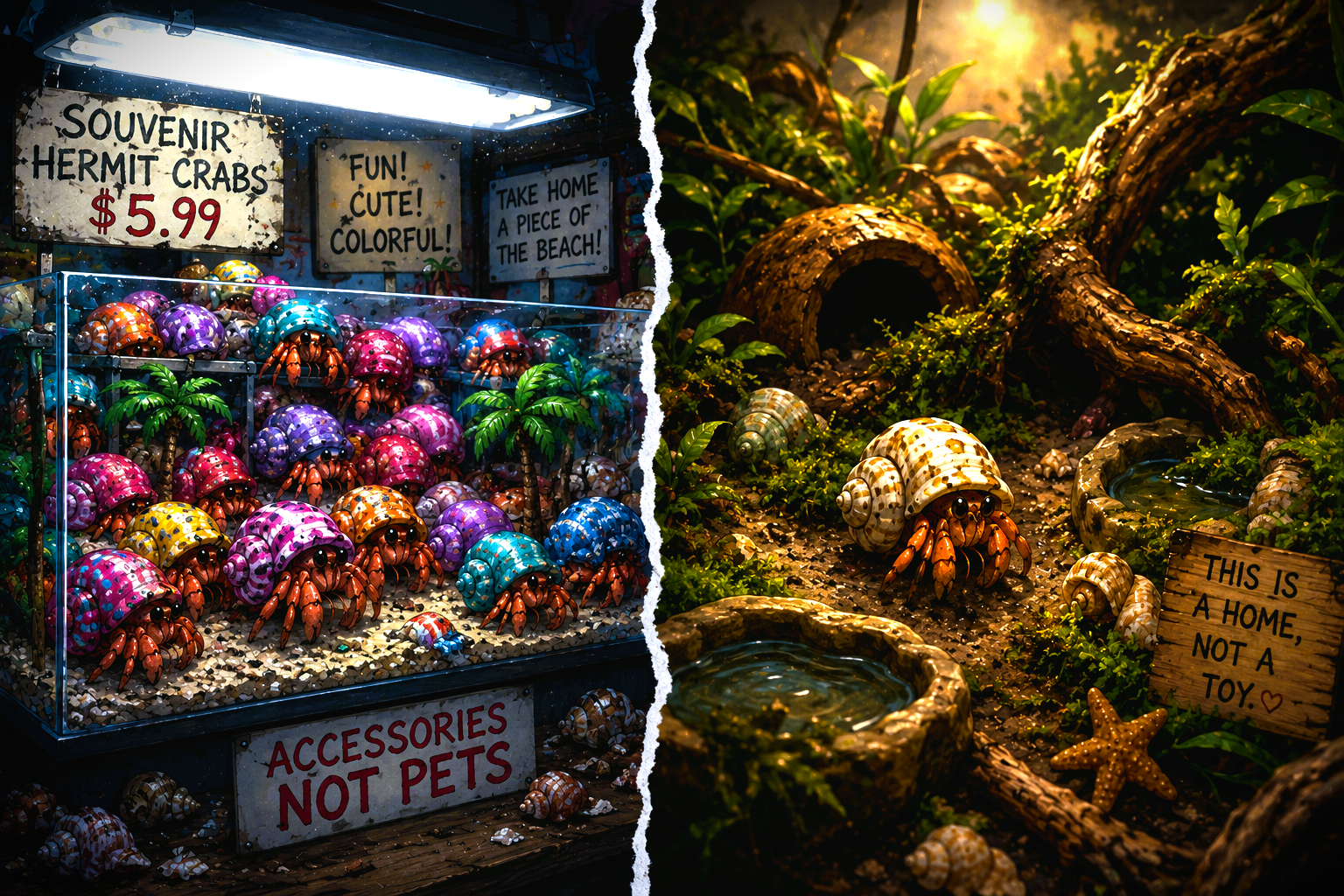
Before I brought my little hermies home, I thought hermit crabs were simple pets. Tiny little beach creatures sitting in colorful shells beside souvenir magnets and airbrushed t-shirts on a crowded boardwalk. You see them next to saltwater taffy and sunglasses, usually inside tiny wire cages with neon gravel and a sad little sponge sitting in the corner. Children point at them excitedly while parents laugh and say: “Sure, why not? They’re easy pets.”
And honestly? That is exactly what I thought too. I thought they were bred for this. I thought there were hermit crab farms somewhere producing tiny crabs specifically for pet stores. I thought the painted shells were cute. I thought those little beach kiosks were harmless.
I was wrong. Painfully wrong. Because every hermit crab sold in those souvenir shops is a wild animal.
Every.
Single.
One.
There is no large-scale captive breeding industry for land hermit crabs because they are incredibly difficult to breed and raise successfully in captivity. So instead, hundreds of thousands are taken directly from tropical beaches every year in places like the Caribbean and Ecuador. Pulled from the only homes they have ever known.
Not because they are dangerous.
Not because ecosystems require population control.
Not because they cannot survive in the wild.
But because humans wanted living souvenirs. Tiny disposable decorations with googly eyes painted onto their shells. And somehow, learning this broke my heart more than I expected. Because now when I look at my little hermies climbing around their tank at night, carefully testing shells and nibbling on food, I cannot stop thinking about where they came from. Somewhere far away, they once crawled freely across warm beaches beneath moonlight and sea air.
Now they sit in glass tanks under artificial heat lamps because humans decided they looked cute enough to sell beside keychains. And somehow we normalized that. One of the cruelest parts of the souvenir trade is the painted shell process itself.
In the wild, hermit crabs naturally search for empty shells as they grow. They carefully inspect them, swap between them, even line up in what scientists call “vacancy chains,” where multiple crabs exchange shells one after another.
It is survival.
Protection.
Home.
But in the commercial trade? Those natural shells are often taken away.
Many hermit crabs are forcibly removed from their original shells through horrific methods like boiling, suffocation, or being physically pried out. Then they are forced into brightly painted shells covered in glitter, dyes, and toxic chemicals because humans think it looks more appealing on a gift shop shelf.
Cute for us.
Deadly for them.
The paint can chip.
The chemicals can be toxic.
The shells can interfere with humidity and natural shell selection behaviors.
And yet they continue to be sold because most people simply do not know.
I did not know.
Then comes the transport process. Which honestly sounds like something out of a nightmare. After being harvested, hermit crabs are crammed into containers and shipped long distances without proper humidity, heat, nutrition, or care. Many arrive dehydrated, starving, injured, or severely stressed before they ever reach a store shelf.
And still…
People are told they are “easy pets.”
Just add sponge.
Tiny cage.
Plastic palm tree.
Done.
Except it is not done.
Because hermit crabs are not decorations.
They are not toys.
They are not impulse purchases.
They are not disposable.
They are living creatures capable of surviving 30 to 40 years in proper conditions.
Thirty.
To.
Forty.
Years.
Yet many sold at souvenir shops do not survive more than a few weeks or months after purchase. Not because hermit crabs are fragile by nature. But because they were failed long before they ever reached the hands of the person trying to save them. And perhaps one of the saddest things I learned is how some shops avoid laws regarding wild-caught animal sales. They market hermit crabs as “accessories.”
Accessories.
As if they are no different than a novelty cup or a beach towel. Tiny lives reduced to trinkets. I think that is the part that sits the heaviest in my chest. Because once you know this, you cannot unknow it. You cannot walk past those little beach stands the same way again.
You notice the dry cages.
The painted shells.
The motionless crabs piled on top of one another beneath fluorescent lights.
And suddenly it is not cute anymore. It is heartbreaking. Now, I know there will probably be people who ask: “Then why did you buy them?”
And honestly? That is a fair question. I struggled with that myself. Because purchasing them unfortunately supports the industry. But at the same time, leaving them there felt impossible too. So now all I can do is try.
Try to give them a proper home.
Try to learn.
Try to do better.
Try to give them the life they should have had from the beginning.
And maybe, through this series, help someone else realize these tiny creatures deserve more than painted shells and plastic cages.
Because they are not souvenirs.
They are survivors.
And now that I know their story…
I think they deserve to be loved like it.
—Bella Imperia
Leave a Reply