
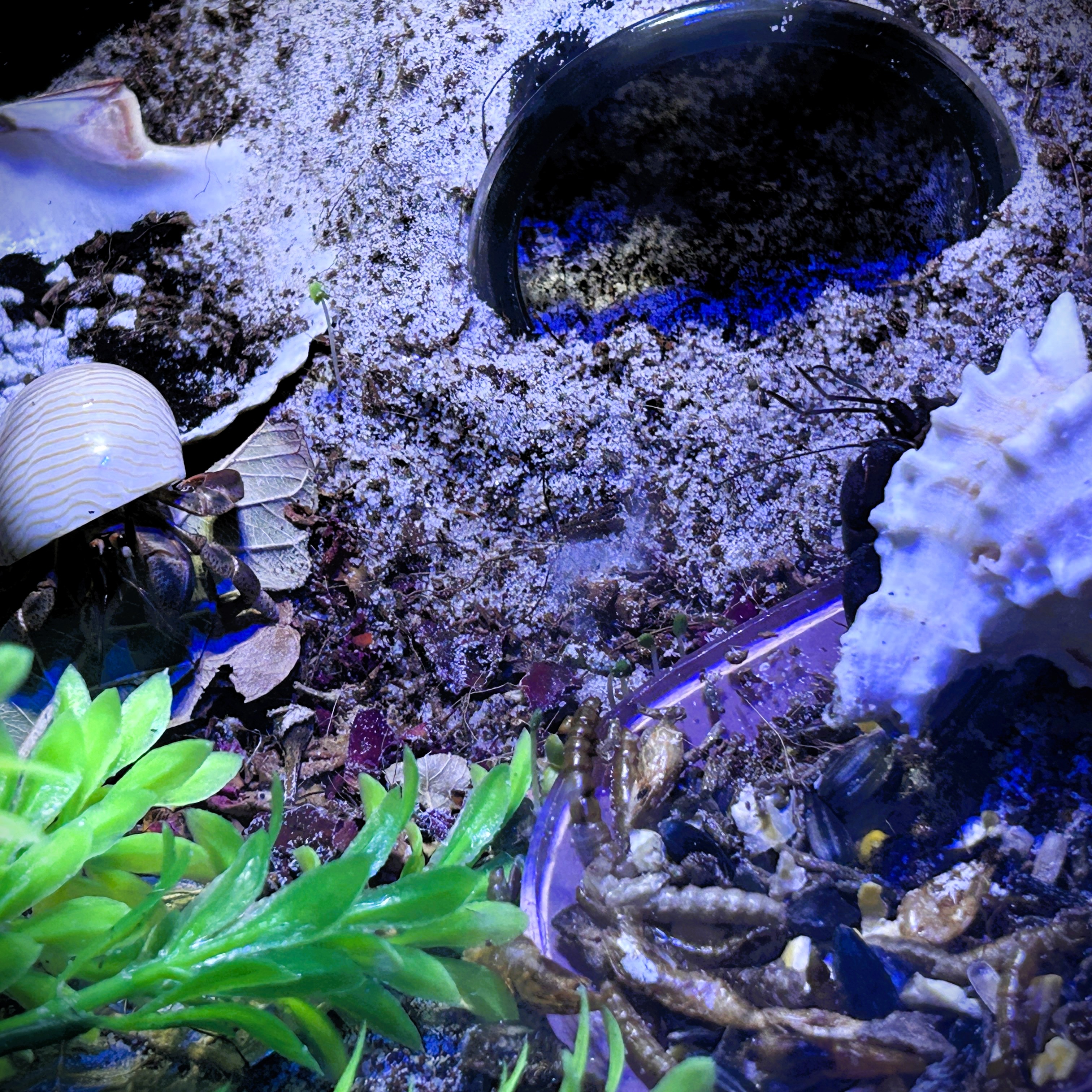
I thought identifying my hermit crabs would be easy. I was wrong. Very wrong. Surely, I thought, I could simply look at my hermit crabs, compare them to a few pictures online, and determine exactly what species they are.
Instead, I found myself several rabbit holes deep, scrolling through forums, studying eye shapes, claw sizes, coloration, body proportions, shell openings, and enough scientific names to make my brain leak out of my ears.
I have read articles. I have researched. I have consulted Reddit. I have consulted the Hermit Crab Association. I have consulted members of the Hermit Crab Association. I have doomed scrolled through TikTok hermit crab videos. I am currently still awaiting additional opinions. And after all of that, I have reached one very important conclusion:
I am terrible at identifying hermit crabs.
Apparently there are more species than I realized, and many of them can look surprisingly similar depending on age, coloration, lighting, and whether your crab has decided to cooperate long enough for a photograph.
Spoiler alert: mine did not.
Meet the Suspects
At the moment, I have narrowed my two crabs down to a handful of possibilities.
The Little One
My smallest hermit crab is light colored—almost tan. Initially, there were two leading theories:
- Purple Pincher (Coenobita clypeatus)
- Ecuadorian (Coenobita compressus)
After showing photos to multiple experienced keepers, the overwhelming consensus seems to be:
Purple Pincher.
So unless new information comes to light, that is the identification I’m going with for now.
The Big One
My larger crab is where the mystery begins. Unlike the smaller crab, this one is much darker. Depending on the lighting, he appears deep red, deep purple, or almost black. Unfortunately, he’s also my shyest crab. The moment he notices movement, he retreats into his shell like I’ve just announced a surprise tax audit. As a result, getting useful photos has been challenging.
The two leading candidates for him are:
- Viola (Coenobita violascens)
- Brevimanus (Coenobita brevimanus)
And honestly?
Everyone seems equally confused. Which makes me feel slightly better about my own inability to identify him.
Purple Pincher (Coenobita clypeatus)
The Purple Pincher is the species most hermit crab keepers encounter. Native to the Caribbean and southern Florida, these crabs are hardy, social, and highly adaptable when provided proper care. Despite often being marketed as “easy” pets, they still require:
- Tropical temperatures
- High humidity
- Freshwater and saltwater pools
- Deep substrate for molting
- Other crab companions
Their modified gills rely on humid air to function properly, making stable humidity one of the most important parts of their care. If my little crab truly is a Purple Pincher, he’s part of the most common species kept in captivity.
Ecuadorian (Coenobita compressus)
The Ecuadorian hermit crab is often described as the speed demon of the hermit crab world. Native to the Pacific coast of Central and South America, they are known for:
- Their distinctive comma-shaped eyes
- High energy levels
- Incredible speed
- Strong burrowing instincts
Ecuadorians require very specific environmental conditions and tend to be more active than Purple Pinchers. They still need both freshwater and saltwater, along with warm temperatures and high humidity, but many keepers consider them a bit more demanding. If my little crab had turned out to be an Ecuadorian, I would have suddenly found myself caring for a tiny caffeinated goblin.
Brevimanus (Coenobita brevimanus)
Often called the “Indo” hermit crab, Coenobita brevimanus is one of the more sought-after species among experienced keepers. Native to tropical Indo-Pacific regions, these crabs are highly terrestrial and spend most of their lives on land. They are known for:
- Larger size potential
- Thick, powerful claws
- Strong personalities
- Specialized care requirements
Because they originate from tropical forest environments, they require consistently warm temperatures and high humidity. Finding one in the pet trade is considerably less common than finding a Purple Pincher.
Viola (Coenobita violascens)
The Viola may be one of the most beautiful hermit crab species in the hobby. Adults are known for developing stunning purple coloration, which is where the species gets its name. They are also famous for:
- Their vibrant coloring
- Their vocal chirping sounds
- Their rarity in captivity
- Their specialized care requirements
Native to the Indo-Pacific region, they thrive in warm, humid environments and are generally considered a species better suited to experienced keepers. Because they are imported less frequently than Purple Pinchers, discovering that you own a Viola can feel a bit like finding a shiny Pokémon. Which is probably why everyone keeps staring at my larger crab and arguing about what he is.
The Verdict?
The current scorecard looks like this:
Little Crab
Most Likely: Purple Pincher (Coenobita clypeatus)
Big Crab
Possibly: Viola (Coenobita violascens)
Possibly: Brevimanus (Coenobita brevimanus)
Definitely: A source of confusion
For now, the mystery continues. Once I receive additional opinions and hopefully gather better photographs, I’ll update everyone with a final verdict. Until then, my tiny crustaceans remain unidentified goblins living rent-free in my house while I spend my evenings staring at pictures of crab eyeballs on the internet.
And somehow, this has become my life.
-Bella Imperia.
Leave a Reply